
As the nation recognizes National Mental Illness Awareness Week, which will culminate with World Mental Health Day o
How One Family’s Philanthropic Investment in Student Research Supported a Groundbreaking Discovery Found Written in the Leaves on UL Lafayette’s Campus
Mon, 05/18/2026 - 10:31am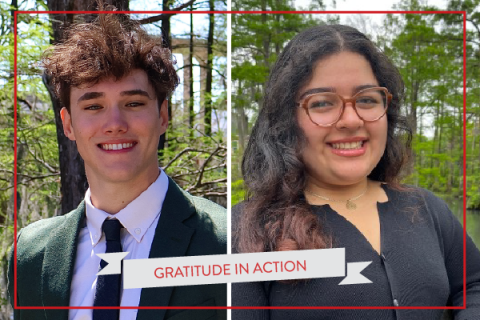
When Izamary Lara and Clinton Vincent set out to analyze the carbon chemistry of the southern live oaks on our campus, they didn't expect to uncover something no scientist had reported before.
Working as undergraduate researchers in the School of Geosciences, under the mentorship of faculty members Dr. Brian Schubert and Dr. Hope Jahren, Clinton and Izamary studied 150 leaves from the iconic southern live oak trees scattered across the University’s grounds. Together, they conducted stable isotope analysis of the leaves, using a device called an isotope-ratio mass spectrometer, which is used to determine the environmental and atmospheric chemistry under which a plant grew.
What they found was striking: the campus oaks contained carbon isotope ratios lower than previously recorded for other oaks, anywhere in the world.
But why? Louisiana's wet climate offered a logical first hypothesis, since plants growing in wet environments are known to show different isotope ratios than those in arid regions. But when the researchers compared their data to that of tropical oaks, the numbers didn't fully explain what they observed.
The answer pointed to something more far-reaching. Prior laboratory experiments at the School of Geosciences had shown that elevated carbon dioxide levels can lead to low carbon-13 to carbon-12 ratios in plants. When Izamary and Clinton compared their field data to those previous findings, the match was clear. As atmospheric CO₂ levels increase, plants are chemically recording lower carbon isotope ratios than they did in the past, including the oaks right here on our campus.
The results have implications that extend across disciplines. For biologists, this work provides a new baseline for tracking how plants respond to rising CO₂. For geoscientists, it opens new possibilities for studying past environmental change using fossil oak leaves, some of which are over 35 million years old.
This groundbreaking research, typically reserved for graduate-level study, was conducted by two exceptional undergraduates, whose work was made possible in-part by philanthropic support from the Vernon and Ruby Langlinais Endowed and Non-Endowed Research Funds in Sciences. The Funds were established by a family member in honor of Vernon and Ruby Langlinais, who were 1949 graduates in Chemistry and Education, respectively – when the University was named SLII. They offer early-stage seed funding for cutting-edge research projects that are driving new discoveries. This support aided the student researchers’ salaries, lab analyses expenses, and participation in two conferences where they shared their findings.
Clinton and Izamary worked on the project from Fall 2024 until graduating this spring with degrees in Chemistry and Environmental Science, respectively. In April 2026, both were honored at the University's Advance Leaf Awards, where Izamary received the Provost Award, the Award for Exceptional Performance in Dissemination, and the Award in Physical Sciences; and Clinton received the Award in Life Sciences.
"We were just two undergraduates trying to understand why our campus trees looked different in the data. We didn't realize we were contributing to a groundbreaking discovery in climate research,” the students recalled. “The support we received made it possible to follow the question wherever it led, to findings we're still processing. We're grateful to be at a university where that kind of curiosity is fostered, and to the Vernon and Ruby Langlinais Funds, whose generosity made sure we had the resources to see it through."